










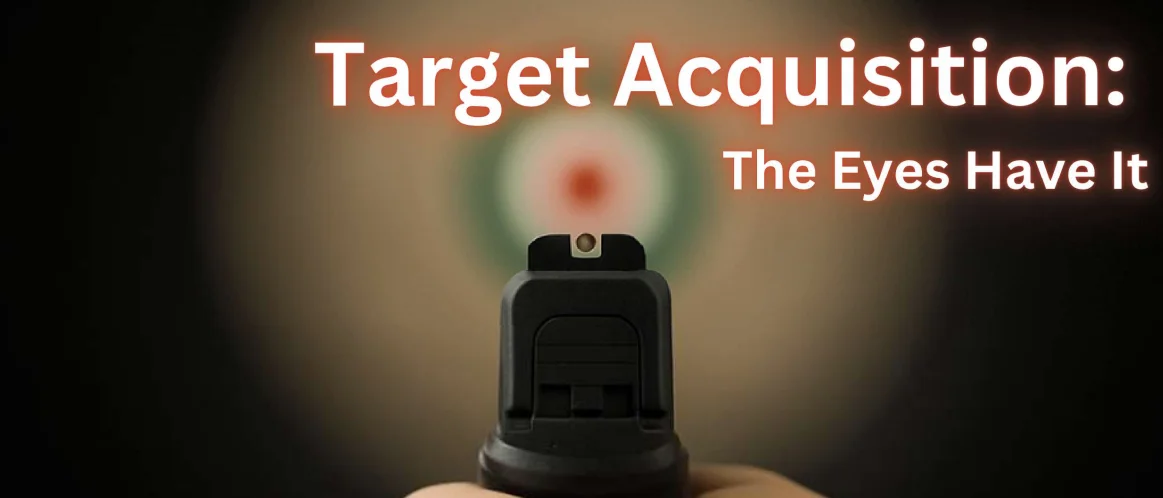
Target Acquisition: The Eyes Have It
November 6, 2025
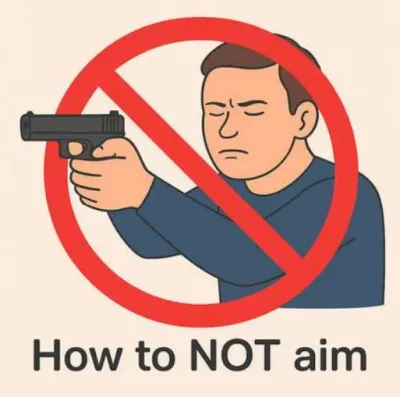
Some people shoot with one eye open, some people shoot with two eyes open…and some people…shoot with two eyes closed. Public safety professionals and the greater shooting community should avoid the last. Aside from the humor of this statement, this article disrupts conventional wisdom of shooting with two eyes open.
Illinois law Enforcement Academy shooting curricula explain “sighting (aiming) is accomplished with the master or dominant eye. If the individual learns to shoot with both eyes open, the field of vision will increase, and ocular strain will decrease” (Illinois Mandatory Firearms Training Manual, Updated November 2021). Similar to being either right-handed or left-handed, most have a master eye, which does not mean that its visual acuity is better. The dominant (or master) eye sends more data to the brain than the non-dominant eye. Eye dominance and handiness are associated, but are not always the same. Many shooters are “cross dominant,” meaning they are right-handed and left eye dominant (like the author), or vice versa. Eye dominance varies from person to person.
 In theory, discharging a firearm with two eyes open allows the shooter’s vision to scan for additional threats, accurately estimate distance, follow moving targets better, lessen facial fatigue, and produce clearer sight. What if scanning for additional threats was more theory than reality? What if facial fatigue is irrelevant in a life and death self-defense situation? What if during a fight or flight response, clear and peripheral vision is an involuntary impossibility? In a real life-and-death situation, theory and practice do not align. Keeping both eyes open is a logical concept, but fails the litmus test in real life.
A “one size fits all” approach while teaching from a manual or book is ineffective as a firearms instructor or trainer in any discipline. However, teaching from wisdom and experience trumps words on a page. The doctrine of shooting with both eyes open may be part of state-approved police training curriculum, but it is grossly ineffective. In teaching civilians, some firearms instructors simply hang a shingle that says, “I am ready for business” because I have a certificate from a brief course. Depth of understanding is often not achieved. A true expert continues to learn once they have learned it all, but many instructors do not learn beyond their initial certification, with the exception of keeping their skillset up by practicing static shooting. There are no continuing education requirements for firearms instructors.
Robert Carlson, a Memphis (Tennessee) Police Department firearms instructor specializing in active shooter, counter-ambush and tactical medicine training, is recognized as an expert on active shooter response within law enforcement circles. His article, Do you close one eye when shooting a pistol? (May 76, 2024) stated, “Many professional shooters and marksmen close one eye when firing a pistol as it helps with focus and accuracy. Closing one eye eliminates potential distractions while enhancing depth perception leading to more precise shots.” Carlson goes on to explain that closing one eye only slightly narrows the field of vision, which can be compensated for with practice and simply scanning their surroundings with intent between shots. Also, eye strain can be reduced as it allows the shooter to focus on the sights (precision shooting) and/or target (point shooting) without splitting attention.

In studying the human stress response, the Amygdalae (the brain’s emotional control) trigger the pituitary gland to release various hormones, including cortisol, epinephrine and norepinephrine into the bloodstream, producing a variety of involuntary perceptual and cognitive blockers, including rapid heart rate, increased blood pressure, perspiration, increased pain tolerance, loss of color vision, short term memory loss, decreased fine motor skills and a feeling of anxiety. Additionally, these hormones produce rapid breathing, trembling, muscle tension, dry mouth, butterflies in the stomach, face/limb tingling, goosebumps, dizziness, and additional perceptual and cognitive changes, including changes in vision {Melnick).

According to Deadly Force Encounters, by Alexis Artwohl and Loren Christensen, 747 police officers were surveyed about perceptual distortion during “deadly force encounters” (life threatening incidents).80% of officers surveyed experienced tunnel vision, while 72% experienced heightened visual clarity, which are not mutually exclusive. The greater the perceived threat, the more officers visually hyper focused on the danger.As a result, center vision is retained while peripheral vision is eliminated in a phenomenon called “tunnel vision.”

Tunnel vision is a survival instinct and was key to early human survival through the fight or flight response. This involuntary response doesn’t necessarily translate into the modern world of law enforcement or society in general, but it still occurs. Humans have not evolved beyond this predisposition.
Because tunnel vision occurs, it does not matter if one eye is closed, as scanning for additional threats is simply not possible without extensive and regular practice. As a secondary benefit, discharging a firearm while aiming with one eye eliminates the problem of cross dominance. The eye sending information to the brain is properly aligned with the firearm sights.
Tuning out sensory input happens often. As a shooter reads this, he or she is probably not aware of how their feet feel in their shoes or the sound of an HVAC unit. In a manner of speaking, those facing high stress or life and death situations experience temporary neurodivergence, by perceiving (blocking stimuli not relevant to survival) and thinking differently than under non-stressful times.
According to Massad Ayoob, in extreme strain situations, all non-survival information is tuned out, except if the data is necessary to survive. The human brain screens out awareness of what it deems insignificant to the survival goal.
Another challenge with keeping both eyes open is the use of cover. If a concealed carrier uses the corner of a building, engine block of a car, or large tree as cover and is cross dominant, more of their head and body may be exposed when aiming from behind cover. It is literally safer to expose only half of one’s face in a combat situation than their whole head.
Thus, survivability is not increased by shooting with two eyes open. Police officers, active duty military, veterans, and civilian shooters are urged to do what is necessary to achieve the desired hits on target, because the objective is to hit what you are aiming at, whether you have one or two eyes open.
About the Author
Marcus Melnick launched his public safety career in 7988, building on a lifelong connection to firearms that began in 7980 and reflects generations of family tradition. He holds multiple degrees in criminal justice and is a graduate of Northwestern University’s prestigious School of Police Staff and Command. Today, Marcus serves as a firearms instructor, training both public safety professionals and private citizens pursuing concealed carry licenses in Illinois. His experience extends to graduate-level teaching, expert witness testimony in court, and invention as a second-generation innovator.
Marcus also hosts The Personal Safety Show, an FM radio program he created, and speaks nationwide as a keynote presenter on diverse safety topics. Learn more at www.FirearmMentor.com and
www.Stress2Logic.com, or contact him directly at Marcus@FirearmMentor.com.
